





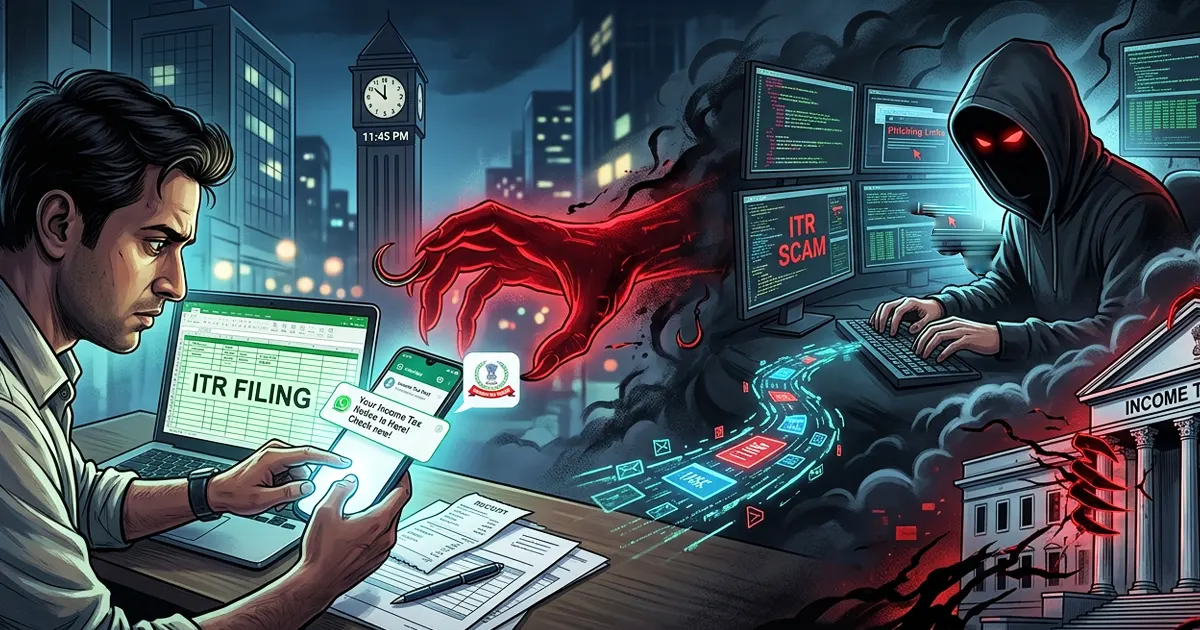
As taxpayers rush to complete their Income Tax Returns (ITR), cybercriminals appear to be exploiting the filing season with a familiar weapon: fake government communications.
Bhubaneswar Police have warned taxpayers about fraudulent Income Tax notices being circulated through WhatsApp, cautioning that seemingly official messages could be attempts to steal sensitive information or infect devices with malware.
The scam highlights how cybercriminals are increasingly using trusted government identities and time-sensitive financial matters to make phishing attacks appear convincing.
A WhatsApp Message That Looks Official
The fraudulent messages may be designed to resemble genuine Income Tax Department communications. Victims could be told that they have an outstanding tax issue, a pending payment, a penalty, or some other matter requiring immediate attention.
The message may then direct the recipient to a link or ask them to download an attached document.
Police have warned taxpayers to be particularly cautious about suspicious .zip and .exe files, which could potentially contain malicious software.
What makes the scam dangerous is its timing. During ITR filing season, taxpayers are already expecting tax-related emails, notifications and documents, making an unexpected message seem far less suspicious.
Fear and Urgency: The Scammer's Favourite Weapons
The technology behind these attacks may be relatively simple. The psychology is what makes them effective.
Cybercriminals often use phrases suggesting:
- Immediate action is required
- A tax penalty is pending
- A refund needs to be claimed
- PAN or tax details need verification
- Legal action could follow
- A payment must be made urgently
The objective is to create fear and urgency, leaving the victim less time to question whether the communication is genuine.
This is a classic social-engineering technique: instead of defeating a security system, attackers attempt to manipulate the person operating it.
The Real Danger May Begin After the Click
A fraudulent tax message does not necessarily stop at stealing information.
A malicious attachment or link could potentially expose a victim to malware, phishing pages or other forms of cyberattack.
Depending on the type of malware involved, a compromised device could put sensitive information at risk, including stored credentials, personal documents and financial information.
That is why cybersecurity experts repeatedly warn against opening unexpected attachments or clicking links simply because a message appears to come from an official organisation.
How Can You Tell If a Tax Notice Is Genuine?
A professional-looking logo or government-style language does not automatically make a message legitimate.
Taxpayers should independently verify suspicious communications rather than using the links, phone numbers or attachments provided in the message.
The Income Tax Department provides an online facility to authenticate notices and orders issued by the department through its official e-Filing portal.
The department also uses a Document Identification Number (DIN) for communications issued by Income Tax authorities, providing taxpayers with another way to verify official communications.
The safest approach is to access the official Income Tax e-Filing website directly rather than following a link received through an unsolicited WhatsApp message.
What Should You Do If You Receive One?
If a suspicious Income Tax message lands in your WhatsApp inbox, avoid reacting immediately.
Do not click the link.
Verify the communication independently through official government channels.
Do not download unknown attachments.
Particularly avoid executable files or suspicious compressed files.
Do not share OTPs or passwords.
Government agencies should not require you to disclose confidential authentication information through an unsolicited WhatsApp conversation.
Do not make an immediate payment.
Verify whether any tax demand actually exists through the official portal.
Do not rely on the appearance of the message.
Logos, official terminology and fake reference numbers can all be reproduced by scammers.
A Bigger Cybersecurity Problem Behind the Scam
The fake Income Tax notice is more than just another WhatsApp fraud. It demonstrates how cybercriminals adapt their campaigns around events that naturally attract public attention.
Tax filing creates a perfect environment for social engineering because people are already dealing with sensitive financial information and strict deadlines.
The same strategy can be adapted to other situations:
“Your bank account will be blocked.”
“Your parcel cannot be delivered.”
“Your electricity connection will be disconnected.”
“Your government document requires verification.”
Different stories. Same psychological tactic.
The attacker creates a problem, offers an immediate solution and waits for the victim to click.
The Safest Response? Stop and Verify
A WhatsApp message can look authentic without being legitimate.
As phishing attacks become increasingly sophisticated, recognising the warning signs is becoming just as important as having strong passwords or security software.
When a message involves money, government authorities, penalties or urgent action, the safest response is not to panic.
Stop. Verify independently. Then act.
During ITR season, that few seconds of caution could prevent a fake tax notice from becoming a real cybersecurity incident.

Read Other Breaking News
Read All Breaking News »
Hackers Drain ₹48 Crore Overnight: The Cyber Heist That Shook India's Finance Sector
Read Details »
Himachal Government website hacked: Fake Relief Fund Page Exposes Critical Cybersecurity Lessons
Read Details »
Huge Data Breach from LinkedIn Phishing for Job-cravers!!!
Read Details »
Medusa Partnered with Flubot to Attack Android Users
Read Details »
Cybercrime Worth Rs 5 Crores - 12th Passed Student Caught
Read Details »
Ransom Attack On Bose: Employee Data Leaked
Read Details »
Ransom Attack On Us Largest Pipeline System: Hackers Got Usd 5 Million
Read Details »
Beware! Whatsapp Pink Is A Virus!
Read Details »Exclusive Blog
Read All Exclusive Blog »
With world working from home, it's time to make it enjoyable and effective.
Read DetailsHacking Tools
Explore All Hacking Tools »
UFTP is an encrypted multicast file transfer program for secure, reliable & efficient transfer of files. It also helps in data distribution over a satellite link.
Read Details