





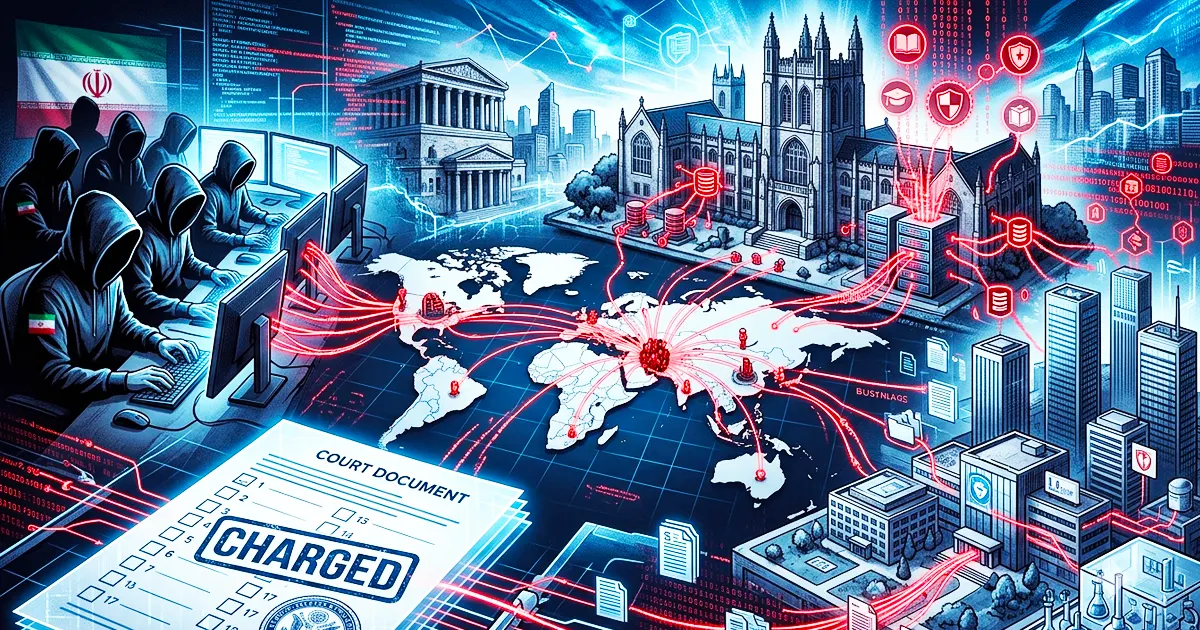
In a major development highlighting the growing scale of global cyber espionage, the United States has charged 17 Iranian nationals in connection with an alleged long-running hacking campaign targeting universities, private companies and government agencies.
According to U.S. prosecutors, the operation allegedly involved members of the Iran-based Mabna Institute and targeted 144 U.S. universities, 178 foreign universities, 42 U.S. private companies, at least 11 foreign companies and multiple government agencies. The alleged campaign, which dates back to at least 2013, resulted in the theft of more than 31 terabytes of academic data and intellectual property.
The case is more than just another international hacking story. It serves as a serious reminder that in today's digital world, knowledge itself has become a high-value target.
What Is the Mabna Institute Hacking Campaign?
The latest charges stem from a superseding indictment connected to an earlier U.S. case involving the Mabna Institute. Prosecutors allege that the organisation operated a coordinated hacking campaign aimed at obtaining valuable research, academic resources, intellectual property and other sensitive information.
The alleged attackers reportedly targeted more than 100,000 academic accounts and successfully compromised around 8,000 professor email accounts. The stolen material reportedly included valuable academic research and intellectual property across multiple fields.
Authorities have alleged that the campaign benefited Iranian government and academic interests, including activities linked to the Islamic Revolutionary Guard Corps. The defendants face charges connected to computer intrusion, wire fraud, identity theft and other alleged offences.
Why Were Universities a Major Target?
When people think about cyberattacks, they often imagine hackers targeting banks, governments or large technology companies. However, universities hold something equally valuable: research, innovation and intellectual property.
Modern universities and research institutions manage enormous volumes of sensitive information, including:
- Scientific and engineering research
- Medical and pharmaceutical studies
- Emerging technology research
- Intellectual property and patents
- Professor and researcher credentials
- Proprietary academic databases
- Unpublished papers, theses and dissertations
- International research collaborations
For a cyber espionage operation, gaining access to this information can provide enormous strategic, commercial and technological advantages.
The alleged Mabna Institute campaign demonstrates how a single compromised academic account can potentially become an entry point to a much larger ecosystem of research databases, institutional networks and valuable intellectual resources.
The Human Element: Why Email Accounts Remain a Cybersecurity Weak Point
One of the most important lessons from this case is that cybersecurity is not only about protecting servers and software. Human identities are often the real target.
Professor and employee email accounts can provide access to cloud platforms, research portals, internal documents, academic libraries and communication networks. Once an attacker gains control of a legitimate account, malicious activity can become much harder to identify.
The campaign allegedly relied heavily on targeting user accounts, demonstrating a familiar reality in cybersecurity: a strong technical infrastructure can still be compromised through a vulnerable identity. This is why organisations increasingly need to focus on:
- Multi-factor authentication
- Strong password and identity management
- Phishing awareness
- Suspicious login detection
- Access control and least-privilege policies
- Continuous security monitoring
- Incident response preparedness
Cybersecurity is no longer just about protecting a network perimeter. It is about protecting every identity that can access the organisation's digital ecosystem.
Cyber Espionage Is a Global Threat, Not Just a Government Problem
The scale of this alleged operation is particularly significant because the targets extended beyond one sector. Universities, private companies, government agencies and international institutions were all reportedly affected. This demonstrates how cyber espionage campaigns can operate across sectors and borders simultaneously.
A research institution may be targeted for scientific knowledge. A private company may be targeted for intellectual property. A government agency may be targeted for sensitive information. The motivation may differ, but the cybersecurity challenge remains the same: valuable digital information attracts sophisticated attackers.
In an increasingly interconnected world, organisations cannot assume that they are too small, too specialised or too geographically distant to become a target.
The Bigger Cybersecurity Lesson: Data Has Become a Strategic Asset
The alleged theft of more than 31 terabytes of data highlights the changing nature of cybercrime and cyber warfare. Today, attackers are not always looking to immediately disrupt a system or demand a ransom. In many cases, the objective is quieter and potentially more damaging in the long term.
Stolen research can accelerate technological development. Intellectual property can provide commercial advantages. Access to institutional networks can support further espionage operations. This makes cybersecurity a critical part of protecting not only business operations but also innovation, research and national competitiveness.
The real value of the data stolen in an espionage campaign may not always be immediately visible. Its impact can emerge years later through technological, commercial or strategic advantages gained from information that was never meant to leave its original institution.
What Organisations Can Learn From This Cyberattack Case
The case offers several important lessons for universities, businesses and other organisations.
1. Every User Account Is Part of the Security Perimeter
A compromised employee, professor or administrator account can provide attackers with access to far more than just email. Identity security must therefore be treated as a core part of cybersecurity strategy.
2. Intellectual Property Needs the Same Protection as Financial Data
Research, proprietary documents and internal knowledge can be extremely valuable targets. Organisations should classify sensitive information and ensure that access is properly controlled and monitored.
3. Cybersecurity Awareness Cannot Be a One-Time Activity
Employees and students must understand modern threats such as phishing, credential theft and social engineering. Regular awareness and practical training can help reduce the risk created by human error.
4. Detection Is as Important as Prevention
No organisation can guarantee that an attack will never succeed. Security teams must also focus on detecting suspicious activity quickly, investigating incidents and limiting the damage caused by compromised accounts.
5. Cyber Threats Are Constantly Evolving
Attack techniques continue to evolve, and organisations must evolve with them. A cybersecurity strategy that worked several years ago may not be enough to defend against today's identity-focused and highly coordinated attacks.
Cybersecurity Education Has Never Been More Important
The alleged campaign against hundreds of universities and organisations reinforces a critical reality: cybersecurity is now a global necessity, not a specialised concern for a small group of IT professionals. As cyber threats become more sophisticated, organisations need skilled professionals who understand how attackers operate, how vulnerabilities are discovered and how digital systems can be protected.
This is where practical cybersecurity education and ethical hacking training play a vital role. Understanding the mindset of an attacker can help security professionals identify weaknesses before those weaknesses are exploited in the real world. Ethical hackers, cybersecurity analysts and security teams are increasingly essential in helping organisations protect their data, identities and digital infrastructure.
Final Thoughts
The U.S. charges against 17 Iranian nationals over the alleged Mabna Institute cyber campaign reveal the enormous scale and long-term impact that cyber espionage operations can have. 144 U.S. universities. Hundreds of institutions worldwide. Thousands of compromised accounts. More than 31 terabytes of allegedly stolen data.
The numbers are significant, but the bigger message is even more important. In the modern digital economy, data is power, research is an asset and identities are gateways. For universities, companies and governments, cybersecurity can no longer be treated as an afterthought. Protecting knowledge, intellectual property and digital identities has become an essential part of protecting the future itself.
As cyber threats continue to evolve, the demand for skilled cybersecurity and ethical hacking professionals will only continue to grow. Because in cybersecurity, the next major attack is not stopped after it happens. It is stopped when someone has the knowledge and skills to identify the threat before the damage is done.

Read Other Breaking News
Read All Breaking News »
Hackers Drain ₹48 Crore Overnight: The Cyber Heist That Shook India's Finance Sector
Read Details »
Himachal Government website hacked: Fake Relief Fund Page Exposes Critical Cybersecurity Lessons
Read Details »
Huge Data Breach from LinkedIn Phishing for Job-cravers!!!
Read Details »
Medusa Partnered with Flubot to Attack Android Users
Read Details »
Cybercrime Worth Rs 5 Crores - 12th Passed Student Caught
Read Details »
Ransom Attack On Bose: Employee Data Leaked
Read Details »
Ransom Attack On Us Largest Pipeline System: Hackers Got Usd 5 Million
Read Details »
Beware! Whatsapp Pink Is A Virus!
Read Details »Exclusive Blog
Read All Exclusive Blog »
With world working from home, it's time to make it enjoyable and effective.
Read DetailsHacking Tools
Explore All Hacking Tools »
UFTP is an encrypted multicast file transfer program for secure, reliable & efficient transfer of files. It also helps in data distribution over a satellite link.
Read Details