





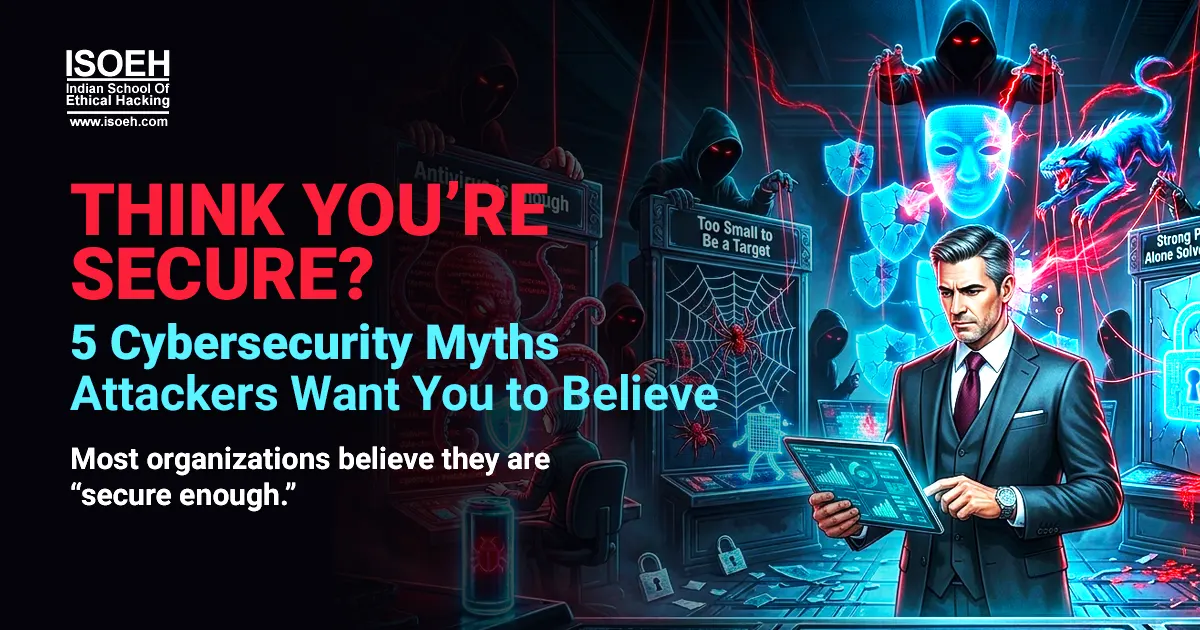
Most organizations believe they are "secure enough."
They have antivirus software.
Employees use passwords.
Maybe even multi-factor authentication is enabled.
So everything should be fine… right?
Not exactly.
Modern cyberattacks no longer rely only on breaking through firewalls or exploiting complex code vulnerabilities. Today's attackers exploit assumptions, overconfidence, and outdated beliefs that still exist inside organizations.
And that is what makes cybersecurity myths so dangerous.
Because the moment businesses think they are safe, attackers already have the advantage.
Let's expose five cybersecurity myths attackers want organizations to keep believing — and uncover the reality behind modern cyber threats.
Myth #1: "We're Too Small to Be Targeted"
This is one of the most common — and most dangerous — misconceptions in cybersecurity.
Small businesses, startups, educational institutions, clinics, and mid-sized organizations often assume attackers only go after massive enterprises with millions of records.
But cybercriminals do not always hunt for the biggest target.
They hunt for the easiest one.
Modern attacks are highly automated. Bots continuously scan the internet searching for weak passwords, exposed servers, outdated software, unsecured cloud storage, and vulnerable users.
Attackers know smaller organizations often lack:
- Dedicated security teams
- 24/7 monitoring
- Advanced threat detection
- Proper employee awareness
- Incident response readiness
And that makes them attractive targets.
In fact, many ransomware groups specifically target smaller organizations because recovery becomes harder, slower, and more chaotic.
The real question is not:
"Why would attackers target us?"
It is:
"What would stop them?"
Myth #2: "Antivirus Means We're Protected"
Antivirus software is important — but it is no longer enough. Traditional antivirus tools were built to detect known malware signatures. The problem is that modern cyberattacks evolve faster than signature databases can keep up.
Today's threats include:
- AI-generated phishing emails
- Fileless malware
- Credential theft
- Social engineering attacks
- Zero-day exploits
- Browser-based attacks
- MFA fatigue attacks
Now think about this: If an employee unknowingly enters credentials into a fake login portal, can antivirus stop that? Usually not. Cybersecurity today requires a layered defense strategy where visibility, monitoring, awareness, and response work together continuously.
Security is no longer a single tool running silently in the background. It is an active ecosystem.
Myth #3: "Strong Passwords Solve Everything"
Strong passwords matter. But attackers have already evolved beyond simple password guessing. Modern cybercriminals steal session tokens, exploit password reuse, deploy infostealer malware, manipulate users through phishing campaigns, and bypass authentication using social engineering tactics.
Even the strongest password becomes useless when:
- Credentials are reused across platforms
- Users approve fake MFA requests
- Devices become infected with malware
- Employees fall for convincing phishing pages
This is why organizations focusing only on password policies often develop a false sense of security. The real challenge today is human behavior. Can employees recognize a sophisticated phishing email generated using AI? Can they identify suspicious login prompts? Can they detect manipulation before damage occurs? Cybersecurity is no longer just about authentication. It is about awareness.
Myth #4: "Cybersecurity Is the IT Team's Job"
Attackers rarely begin with technology. They begin with people.
- One careless click.
- One fake invoice attachment.
- One exposed credential.
- One unauthorized application install.
That is often enough to compromise an entire organization. Yet many companies still treat cybersecurity as something handled exclusively by the IT department. That approach no longer works.
Every employee interacts with sensitive systems, emails, cloud applications, customer data, and communication platforms. This makes every employee part of the organization's security posture.
A company can invest heavily in advanced security infrastructure, but if employees are not trained to recognize threats, attackers will simply bypass technology through human error. Cybersecurity culture matters more than ever. And culture cannot be installed like software. It must be built continuously through awareness, practice, and preparedness.
Myth #5: "If We're Breached, We'll Know Immediately"
Most organizations assume cyberattacks are loud, obvious, and immediate. The reality is often the opposite. Modern attackers are patient.
They quietly steal credentials, observe network activity, escalate privileges, move laterally across systems, and extract sensitive information while remaining undetected for weeks or even months. Sometimes organizations only discover breaches after:
- Customers report suspicious activity
- Critical systems fail
- Ransom demands appear
- Sensitive data surfaces online
- Financial damage has already occurred
This is why proactive threat monitoring has become critical. Detection speed can determine whether a security incident becomes manageable — or catastrophic. Organizations without continuous visibility often discover attacks far too late.
The Biggest Threat? False Confidence
Cybersecurity myths create dangerous confidence. And false confidence is exactly what attackers exploit. When organizations believe:
- "It won't happen to us"
- "Our antivirus is enough"
- "Our passwords are strong"
- "IT will handle it"
- "We'll know if something happens"
…they stop questioning their vulnerabilities. That is where the real risk begins. Cybersecurity is not about creating fear. It is about building awareness, visibility, preparedness, and resilience in a rapidly evolving threat landscape. Because attackers are adapting every day. Organizations must do the same.
So What Should Businesses Focus On Instead?
Instead of chasing the illusion of "perfect security," organizations should focus on strengthening their overall cyber resilience through:
- Continuous employee awareness training
- Real-time threat detection and monitoring
- Vulnerability assessments and penetration testing
- Strong identity and access management
- Incident response readiness
- Proactive SOC operations
- AI-powered visibility into suspicious behavior
Cybersecurity is no longer optional infrastructure. It is business continuity. It is trust. It is survival.
Building Smarter Cyber Defense with ISOEH
At ISOEH, cybersecurity is approached as a connected ecosystem where technology, people, intelligence, and proactive defense work together continuously.
Through advanced solutions like Secveil for intelligent threat visibility, cybersecurity awareness programs that strengthen the human layer, and managed security services backed by skilled SOC analysts, red teamers, researchers, and ML engineers — the focus remains on helping organizations stay prepared against evolving cyber threats.
Because modern cybersecurity is not just about reacting to attacks. It is about staying ready before they happen.

Read Other Articles
Read All Articles »
Quick look at the 10 facts you need to know about the latest Facebook hack
Read Details »
Top certifications in cyber security industry
Read Details »
Building a career in IoT: A thorough guide
Read Details »
The mystery of UIDAI : Who & Why!! Is it a threat? A detailed discussion
Read Details »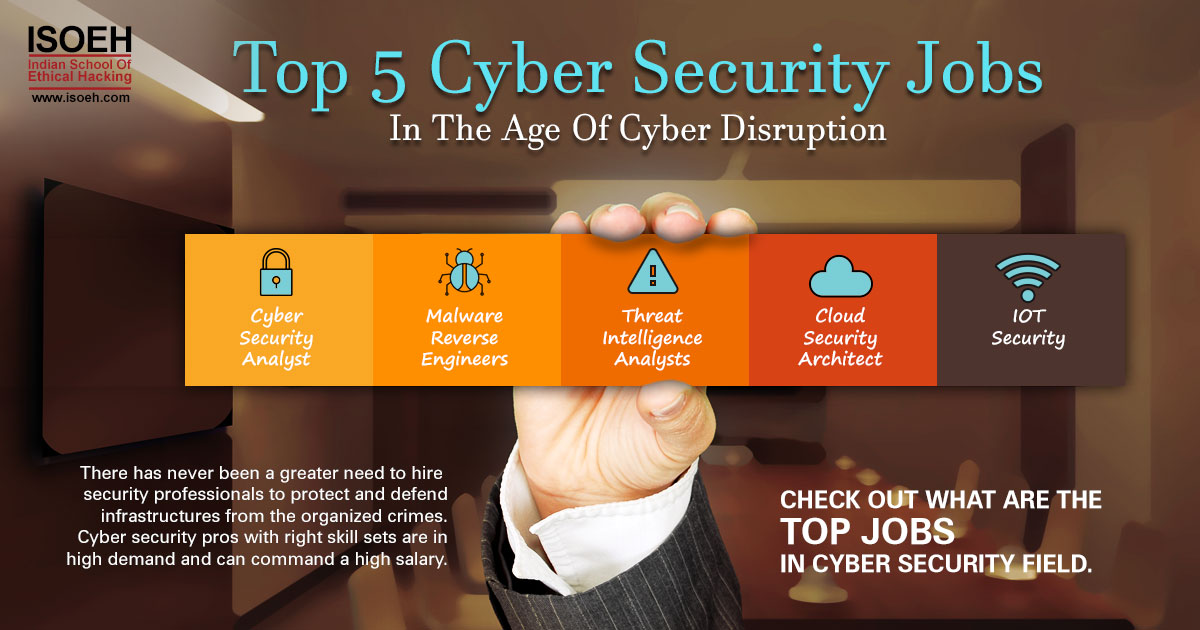
Top 5 cyber security jobs in the age of Cyber Disruption
Read Details »
Top Cyber Security trends of 2018
Read Details »
A severe vulnerability in Signal desktop app allowing hackers to steal chats in plaintext without any user interaction
Read Details »
Cambridge Analytica and Facebook Controversy: What happened so far?
Read Details »
Equifax identifies an additional 2.4 million U.S. consumers affected by the massive data breach of 2017
Read Details »
Severe flaw in µTorrent can let hackers to control your PC remotely
Read Details »
Cyber Criminals are turning into Cryptominers, Dominating Cyber Threat Landscape
Read Details »
Android Banking Trojan targets over 232 banking apps, including Indian banks
Read Details »
Private end-to-end encrypted Whatsapp group chats are not secured anymore!
Read Details »
Top Cyber Attacks In 2017
Read Details »Hacking Tools
Explore All Hacking Tools »
UFTP is an encrypted multicast file transfer program for secure, reliable & efficient transfer of files. It also helps in data distribution over a satellite link.
Read DetailsBreaking News
Breaking News Of Each Month »
The recent pandemic was unexpected and unknown to most part of the world. It has changed our life and we are slowly adapting to our new lifestyle. The risks associated with the new lifestyle, both personal & corporate, are unknown to most of us.
Read Details