





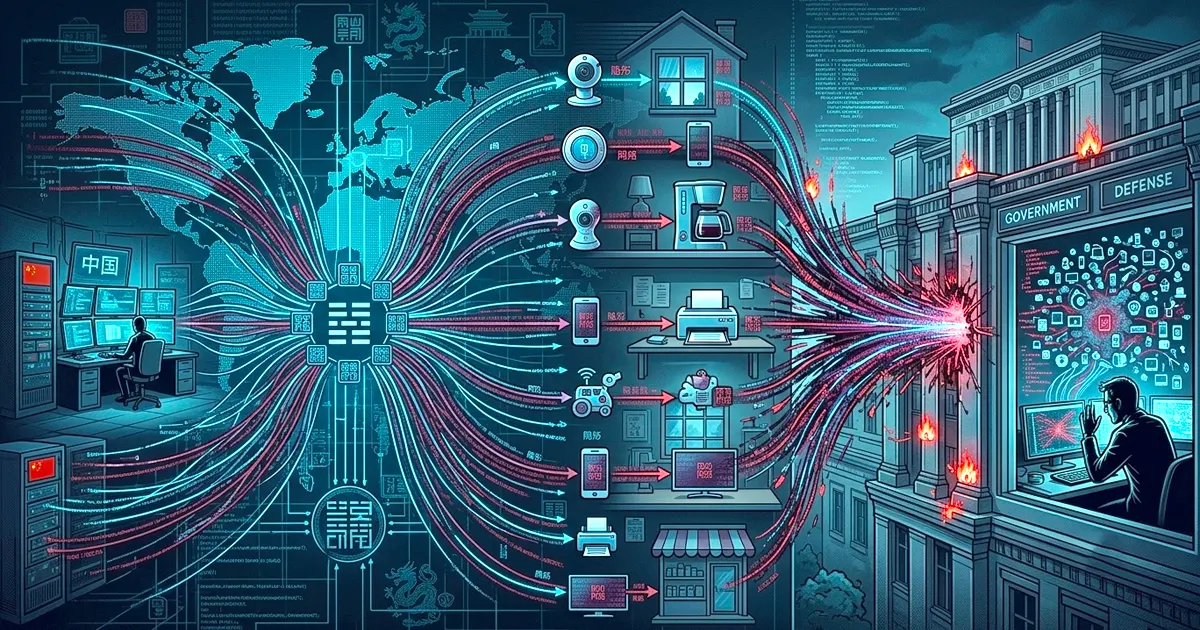
What if the traffic appeared to come from a router, a network device or an ordinary internet-connected machine somewhere else in the world?
That is the unsettling idea at the centre of an eight-year cyber-espionage campaign that U.S. authorities have linked to a China-based hacking group known as QTFY.
The operation reportedly used thousands of compromised internet-connected devices to hide the origin of attacks targeting sensitive U.S. networks. Among the organisations identified as targets were NASA, the Federal Reserve and the U.S. Senate, along with organisations connected to energy, healthcare, telecommunications and defence.
But there is an important detail hidden behind those headlines: being targeted does not automatically mean being hacked. A later clarification from the U.S. Department of Justice made clear that some organisations were targets rather than confirmed victims of successful intrusions. And that distinction tells us something important about how cyberattacks actually work.
The real story is not simply who was targeted. It is how the attackers operated - and how they managed to stay in the shadows for so long.
The Attack Didn't Begin in 2026
The campaign reportedly goes back to at least 2018. That alone makes the incident remarkable. Cybersecurity news often focuses on the moment an attack is discovered. But sophisticated espionage campaigns can have much longer lifespans. Attackers can spend years scanning for weaknesses, testing defences, collecting credentials and changing their infrastructure.
If one door closes, they look for another. That appears to be part of what made the QTFY operation difficult to track. According to U.S. investigators, the group developed two platforms - QScan and QTRouter - that worked together to support its operations. QScan reportedly searched the internet for vulnerable IoT devices, while QTRouter used compromised devices and other infrastructure to conceal malicious traffic. And that is where the story gets particularly interesting.
Your Router Could Become Someone Else's Weapon
Imagine discovering that your router had been hacked. You might worry about someone accessing your personal information or stealing your passwords. But there is another possibility. Your device could be used to attack someone else.
According to U.S. authorities, QScan was capable of automatically scanning for vulnerable IoT devices and compromising them. Thousands of devices could then become part of the QTRouter network. The attacker could effectively create a chain such as:
Attacker → Compromised Device → Proxy Network → Target
The target sees traffic coming from the compromised device rather than directly from the attacker. That makes tracing the real source considerably harder. And the device owner may have absolutely no idea that their hardware has become part of a cyber operation. This is one of the most important lessons from the case: an insecure device does not only threaten its owner. It can potentially become infrastructure for attacks against others.
Why Would Hackers Need Thousands of Devices?
Because scale creates cover. A single suspicious connection is easier to investigate. Thousands of compromised devices spread across different locations create a much more complicated picture. The QTRouter infrastructure reportedly combined compromised devices with commercial proxy services and leased servers. That gave the attackers multiple layers through which their activity could move. For defenders, this creates a difficult question:
When malicious traffic arrives, where did it really come from?
The IP address may point to a compromised device. That device may point to a proxy. The proxy may point to another server. By the time investigators follow the trail, the original attacker can be several steps removed from the activity. Cybersecurity is therefore not always a battle of “attacker versus defender.” Sometimes it is a battle of visibility versus concealment.
NASA Was Targeted. That Doesn't Mean NASA Was Breached.
This is where the headlines can become misleading. NASA, the Federal Reserve and the Senate were among the organisations identified as targets, but U.S. officials later clarified that they should not all be described as confirmed victims. The FBI affidavit provides examples of both successful and unsuccessful attempts.
In one case, an attempted intrusion involving NASA in 2019 reportedly failed because the targeted software had already been patched. Other organisations, however, were identified as having suffered successful intrusions. That small detail carries a major cybersecurity lesson.
There is a huge difference between: “An attacker found you.” and “An attacker got inside.”
Cyberattacks typically move through several stages: Reconnaissance → Targeting → Exploitation → Compromise → Persistence → Data Access → Exfiltration
Stopping the attack at any stage can prevent the final objective. In NASA's case, according to the affidavit, patching reportedly helped stop one attempted intrusion. Sometimes the most powerful defence against a sophisticated attacker is still a very basic one: fix the vulnerability before it can be exploited.
The IoT Problem Is Bigger Than It Looks
The QTFY campaign also highlights a growing weakness in cybersecurity: connected devices are everywhere, but visibility isn't. Companies spend enormous resources protecting databases, employee computers and cloud systems. Yet thousands of routers, cameras, network appliances and other connected devices can sit around the edges of those environments.
Some may run outdated firmware. Some may expose unnecessary services. Some may use weak or poorly managed credentials. And some may not be monitored nearly as closely as traditional IT systems. For attackers, that can be enough. The device doesn't need to contain sensitive information. It simply needs to provide access, connectivity or cover. That changes how organisations should think about their attack surface.
The question is no longer just: “What valuable information is stored on this device?” It is also: “What could an attacker do with this device if they controlled it?”
The Hacker Wasn't Necessarily Working Alone
The investigation also points towards a more organised model of cyber operations. U.S. authorities allege that QTFY was associated with Nanjing Xinjiuwei Network Technology Company, which allegedly provided hacking services to customers including China's Ministry of State Security and People's Liberation Army. This suggests something larger than an individual hacker sitting behind a computer.
Modern cyber operations can involve specialised capabilities working together:
- vulnerability discovery
- automated scanning
- exploit development
- malware
- infrastructure management
- credential theft
- intelligence collection
In effect, cyber espionage can operate like a service ecosystem. That makes defending against it harder because the person launching an attack may not be the person who developed the tool or operates the infrastructure behind it.
Taking Down the Network Is Not the Same as Ending the Threat
In August 2026, U.S. authorities seized domains associated with QScan and QTRouter, disrupting infrastructure that investigators said was important to the operation. It is a significant move. But cybercriminal and state-linked infrastructure can be rebuilt.
A domain can disappear. Another can appear. A compromised device can be replaced with another. A vulnerability can be patched—and a new one can eventually be discovered. That is why infrastructure takedowns are only one part of the defence. The harder task is reducing the attacker's options.
What This Means for Cybersecurity Teams
The QTFY case offers some straightforward but critical lessons.
Patch internet-facing systems.
A vulnerability that remains exposed can become an invitation to automated scanning.
Know every device connected to your network.
Unknown IoT devices create unknown risks.
Watch outbound traffic.
A compromised device may reveal itself by communicating with suspicious infrastructure.
Protect credentials.
A valid username and password can sometimes be more useful to an attacker than an exploit.
Segment sensitive systems.
A compromised router or endpoint should not provide a direct path into critical infrastructure.
Hunt for threats continuously.
If attackers can operate for years, defenders cannot afford to look only when an alert appears.
The Bigger Warning
The most disturbing part of this story may not be that NASA or the U.S. Senate appeared on an attacker's target list. It is the idea that the infrastructure carrying the attack may belong to someone completely unrelated to it. A router can become a relay. An IoT device can become a hiding place. A stolen credential can become a key. And a vulnerability that nobody noticed can become an entry point.
The QTFY campaign is therefore a reminder that modern cyber warfare is not always loud. There may be no ransomware screen, no obvious system shutdown and no dramatic warning. Sometimes, the attacker simply waits. And if an organisation cannot see what is happening across its own digital environment, that silence can last for years.
The most dangerous device on a network may not be the one holding the most valuable data. It may be the one nobody thought to watch.

Read Other Breaking News
Read All Breaking News »
Hackers Drain ₹48 Crore Overnight: The Cyber Heist That Shook India's Finance Sector
Read Details »
Himachal Government website hacked: Fake Relief Fund Page Exposes Critical Cybersecurity Lessons
Read Details »
Huge Data Breach from LinkedIn Phishing for Job-cravers!!!
Read Details »
Medusa Partnered with Flubot to Attack Android Users
Read Details »
Cybercrime Worth Rs 5 Crores - 12th Passed Student Caught
Read Details »
Ransom Attack On Bose: Employee Data Leaked
Read Details »
Ransom Attack On Us Largest Pipeline System: Hackers Got Usd 5 Million
Read Details »
Beware! Whatsapp Pink Is A Virus!
Read Details »Exclusive Blog
Read All Exclusive Blog »
With world working from home, it's time to make it enjoyable and effective.
Read DetailsHacking Tools
Explore All Hacking Tools »
UFTP is an encrypted multicast file transfer program for secure, reliable & efficient transfer of files. It also helps in data distribution over a satellite link.
Read Details