





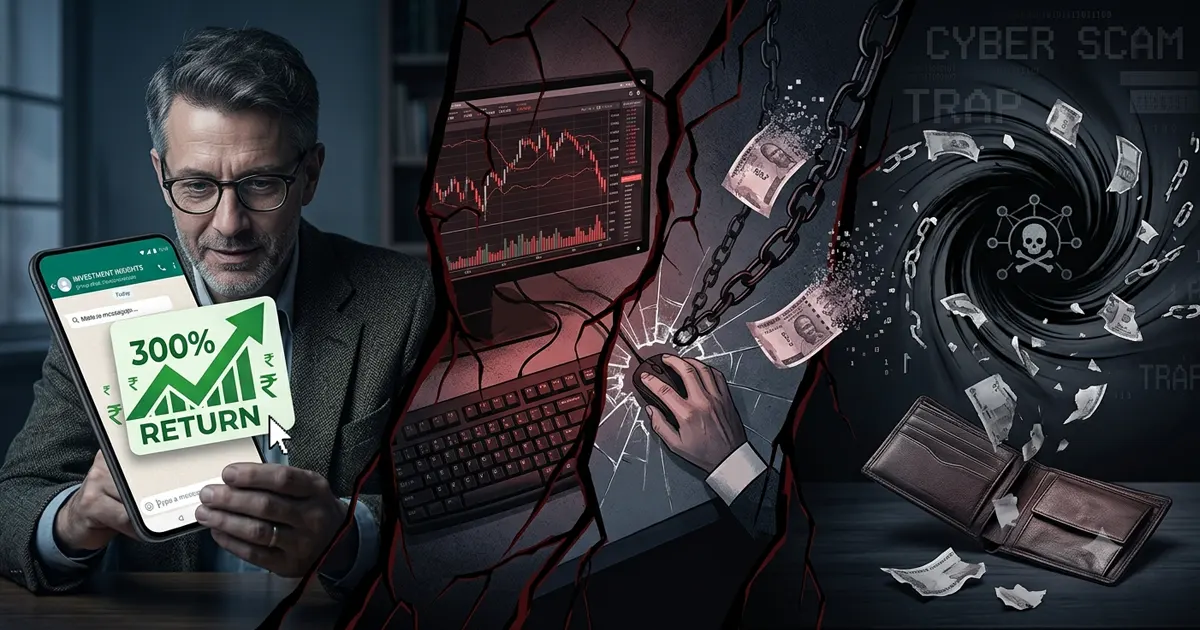
A retired professor from Bengaluru has become the latest victim of a sophisticated online trading scam after fraudsters lured him with promises of 300% investment returns through a fake investment programme called the "Kanishka Scheme."
What started as a social media advertisement quickly turned into a financial nightmare.
According to the complaint, the victim clicked on an attractive investment advertisement that redirected him to WhatsApp. Soon, he was added to investment groups where so-called market experts regularly shared stock tips, IPO recommendations, and screenshots of massive profits. To make everything appear genuine, the fraudsters even claimed their platform was registered with India's financial regulator.
Believing he was investing in a legitimate opportunity, the professor transferred ₹2.05 crore over a period of 36 days to multiple bank accounts.
Only when he tried to withdraw his money did he discover the truth.
His profits were fake.
His account balance was fabricated.
His money was gone.
The case is now under investigation by cybercrime police.
The Scam Was Never About Trading—It Was About Trust
Unlike traditional frauds that rely on crude tactics, modern investment scams are carefully designed to appear professional.
The fraudsters created an ecosystem that looked convincing from every angle:
- A polished social media advertisement
- Instant redirection to WhatsApp
- Active investment groups filled with "successful investors"
- Daily stock market discussions
- Fake experts offering investment advice
- A professional-looking trading website
- Artificial profits displayed on the dashboard
Everything was designed to convince the victim that the platform was genuine. Unfortunately, none of it was real.
The Biggest Red Flag? "Guaranteed" High Returns
No legitimate investment platform can promise extraordinary profits with little or no risk. Whenever one hears claims such as:
- Earn 200% or 300% returns
- Guaranteed profits
- Zero risk investing
- Exclusive VIP investment group
- Limited-time opportunity
He or she should immediately question the legitimacy of the offer. If it sounds too good to be true, it almost always is.
How These Fake Trading Scams Usually Work
Cybercriminals generally follow a predictable pattern:
Step 1: They attract victims through Facebook, Instagram, YouTube or other social media advertisements.
Step 2: The victim is redirected to WhatsApp or Telegram.
Step 3: Fake investment experts begin building trust.
Step 4: Victims are asked to register on a professional-looking trading website.
Step 5: The platform starts displaying fake profits.
Step 6: Encouraged by the apparent success, victims invest larger amounts.
Step 7: When they attempt to withdraw money, excuses begin—taxes, verification fees, account upgrades, or technical issues.
Step 8: Eventually, the scammers disappear.
How to Protect Yourself from Similar Investment Frauds
Before investing even a single rupee:
- Never trust investment advertisements on social media.
- Avoid joining investment schemes promoted through unsolicited WhatsApp or Telegram groups.
- Independently verify whether the company and intermediaries are genuinely registered with the appropriate regulators.
- Research the platform through official sources—not links shared by strangers.
- Never invest simply because others in a chat group appear to be making profits.
- Be especially cautious if you're pressured to invest quickly or repeatedly.
A few minutes of verification can save years of hard-earned savings.
Already Sent Money? Act Immediately
If someone suspects he or she has fallen victim to an online investment scam:
- Stop making any further payments immediately.
- Preserve screenshots, chat histories, transaction receipts, website URLs and account details.
- Contact your bank and request that the transaction be reported as fraudulent.
- Report the incident to the National Cyber Crime Helpline by dialling 1930 as quickly as possible.
- File a complaint through the National Cyber Crime Reporting Portal.
- Lodge an FIR with your nearest cybercrime police station.
Time is critical. Early reporting significantly improves the chances of tracing or freezing fraudulent transactions.
The Real Investment Isn't High Returns—It's Cyber Awareness
The Bengaluru professor's case is another reminder that cybercriminals no longer rely on poorly written emails or obvious scams. They use polished websites, social media marketing, fake financial experts and psychological manipulation to earn victims' trust before stealing their money.
As online investment frauds continue to rise, awareness remains the strongest defence. Always verify before you invest, question promises of extraordinary returns, and remember—legitimate wealth is built through informed decisions, not guaranteed shortcuts.
Stay alert. Stay informed. Stay cyber safe.

Read Other Breaking News
Read All Breaking News »
Hackers Drain ₹48 Crore Overnight: The Cyber Heist That Shook India's Finance Sector
Read Details »
Himachal Government website hacked: Fake Relief Fund Page Exposes Critical Cybersecurity Lessons
Read Details »
Huge Data Breach from LinkedIn Phishing for Job-cravers!!!
Read Details »
Medusa Partnered with Flubot to Attack Android Users
Read Details »
Cybercrime Worth Rs 5 Crores - 12th Passed Student Caught
Read Details »
Ransom Attack On Bose: Employee Data Leaked
Read Details »
Ransom Attack On Us Largest Pipeline System: Hackers Got Usd 5 Million
Read Details »
Beware! Whatsapp Pink Is A Virus!
Read Details »Exclusive Blog
Read All Exclusive Blog »
With world working from home, it's time to make it enjoyable and effective.
Read DetailsHacking Tools
Explore All Hacking Tools »
UFTP is an encrypted multicast file transfer program for secure, reliable & efficient transfer of files. It also helps in data distribution over a satellite link.
Read Details