





Imagine this.
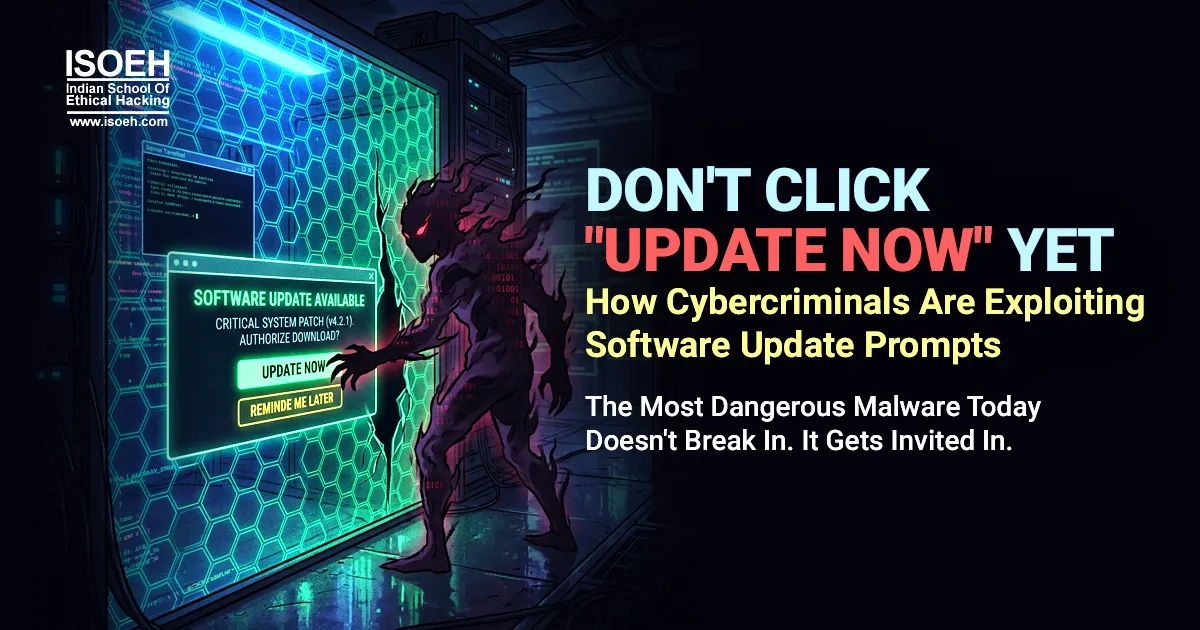
You're working on an important project. A notification suddenly appears on your screen:
"Your browser is out of date. Update now to stay protected."
It looks genuine. The logo is familiar. The design resembles the software you use every day.
So you click.
Within seconds, you've unknowingly opened the door to cybercriminals.
No hacking skills were required.
No security vulnerability was exploited.
Just one click.
This is the alarming reality behind the latest wave of cyberattacks that are sweeping across the digital landscape. Threat actors are increasingly using fake software update prompts to trick users into installing malware, stealing credentials, and granting remote access to their devices. Recent investigations have shown that thousands of websites have been compromised and weaponized to distribute these deceptive "updates," making this one of the fastest-growing social engineering attacks in cybersecurity today.
The Psychology Behind the Perfect Cyber Scam
Cybercriminals have discovered a simple truth:
People trust updates.
For years, cybersecurity experts have encouraged users to keep their software updated. Ironically, attackers are now exploiting that very habit.
Instead of forcing their way into systems, hackers are disguising malware as security updates, browser patches, video codecs, operating system upgrades, and even productivity software enhancements.
The result?
Victims willingly download the malicious file themselves.
Think about it:
When was the last time you questioned a software update notification?
Probably never.
That's exactly why these attacks are so effective.
Why Fake Update Attacks Are Becoming More Dangerous Than Traditional Malware
Traditional malware campaigns often relied on suspicious email attachments or obviously malicious links.
Today's fake update campaigns are different.
They're smarter.
They're cleaner.
And they're disturbingly convincing.
Researchers have observed attackers creating update screens that closely mimic legitimate Windows, Chrome, Edge, and macOS interfaces. Some campaigns even display full-screen update pages that appear virtually identical to genuine system updates.
In many cases, victims are redirected from legitimate websites that have been silently compromised by attackers.
Which means users aren't necessarily visiting a suspicious website.
They're visiting a website they already trust.
That trust becomes the weapon.
"But I Have Antivirus..." — Why That's No Longer Enough
Here's the uncomfortable truth.
Many people believe antivirus software will automatically stop every cyber threat.
Unfortunately, modern fake update attacks often bypass that assumption.
Some malicious installers are disguised using legitimate software frameworks, making them appear harmless to traditional security tools. Security researchers have even documented cases where fake update malware initially evaded detection across dozens of antivirus engines.
The attack succeeds not because security software fails.
It succeeds because the user is convinced to approve the action.
When a user willingly downloads and executes a malicious file, the attack often appears as legitimate behavior.
And that's exactly what makes social engineering so powerful.
What Happens After You Click?
Many people assume the worst outcome is a slow computer.
The reality is far more serious. A fake software update can secretly install:
- Credential-stealing malware
- Remote Access Trojans (RATs)
- Spyware
- Ransomware
- Banking malware
- Information stealers
In some campaigns, attackers gain the ability to monitor activity, harvest saved passwords, collect financial information, and even take complete control of the infected device.
Now ask yourself:
How much of your life exists on your device?
- Emails.
- Bank accounts.
- Work documents.
- Personal photos.
- Social media accounts.
The value of a successful compromise is far greater than most people realize.
Five Seconds of Verification Can Save Years of Damage
The good news? These attacks are highly preventable. Before clicking any update notification, pause and ask:
Did the notification come from the software itself?
Legitimate updates typically originate from the application or operating system—not from random websites or pop-up advertisements.
Is the message creating urgency?
Words like:
- Critical Update
- Immediate Action Required
- Security Risk Detected
- Update Now
are often designed to trigger panic and rushed decisions.
Does the update ask you to run commands manually?
This is a major red flag. Real software updates do not require users to open Run dialogs, paste commands, or execute PowerShell scripts.
Were you actually expecting an update?
Unexpected update prompts appearing while browsing unrelated websites deserve immediate skepticism.
The Golden Rule Every Internet User Should Remember
If you remember only one thing from this article, remember this:
Never update software through a website pop-up.
Instead:
Open the application directly. Navigate to Settings. Check for updates from the official source.
Whether it's Windows, Chrome, Edge, Firefox, Adobe software, or any business application, updates should always be initiated through the software's official update mechanism.
A genuine update will wait for you. A fake one will try to pressure you. Cyber Awareness Is the New Antivirus. Technology continues to evolve. Attackers evolve with it.
Artificial intelligence, realistic interfaces, compromised websites, and advanced social engineering techniques are making cyber scams more believable than ever before.
The strongest defense is no longer just a security tool. It's an informed user. Every click is a decision. Every download is a trust exercise. And every update prompt deserves a second look.
Final Thoughts: Stay Updated, But Stay Alert
Cybercriminals know that people trust software updates. That's why fake update attacks have become one of the most successful malware delivery techniques in recent years. Thousands of compromised websites and increasingly sophisticated social engineering campaigns continue to put users and organizations at risk.
The next time a pop-up urgently demands an update, don't react.
Investigate. Verify. Then act.
Because in today's threat landscape, the difference between staying secure and becoming a victim may be just one click.
Turn Cyber Awareness into Cyber Expertise with ISOEH
Every cyberattack leaves behind a lesson. The question is: will you learn it before or after becoming a victim?
As cybercriminals continue to leverage tactics like fake software updates, phishing campaigns, and malware-driven attacks, the demand for skilled cybersecurity professionals has never been greater.
At ISOEH, we bridge the gap between theory and real-world practice through comprehensive cybersecurity training, hands-on labs, industry-oriented learning, and expert mentorship. Our mission is to prepare the next generation of cyber defenders who can confidently tackle today's evolving threat landscape.

Read Other Articles
Read All Articles »
Quick look at the 10 facts you need to know about the latest Facebook hack
Read Details »
Top certifications in cyber security industry
Read Details »
Building a career in IoT: A thorough guide
Read Details »
The mystery of UIDAI : Who & Why!! Is it a threat? A detailed discussion
Read Details »
Top 5 cyber security jobs in the age of Cyber Disruption
Read Details »
Top Cyber Security trends of 2018
Read Details »
A severe vulnerability in Signal desktop app allowing hackers to steal chats in plaintext without any user interaction
Read Details »
Cambridge Analytica and Facebook Controversy: What happened so far?
Read Details »
Equifax identifies an additional 2.4 million U.S. consumers affected by the massive data breach of 2017
Read Details »
Severe flaw in µTorrent can let hackers to control your PC remotely
Read Details »
Cyber Criminals are turning into Cryptominers, Dominating Cyber Threat Landscape
Read Details »
Android Banking Trojan targets over 232 banking apps, including Indian banks
Read Details »
Private end-to-end encrypted Whatsapp group chats are not secured anymore!
Read Details »
Top Cyber Attacks In 2017
Read Details »Hacking Tools
Explore All Hacking Tools »
UFTP is an encrypted multicast file transfer program for secure, reliable & efficient transfer of files. It also helps in data distribution over a satellite link.
Read DetailsBreaking News
Breaking News Of Each Month »
The recent pandemic was unexpected and unknown to most part of the world. It has changed our life and we are slowly adapting to our new lifestyle. The risks associated with the new lifestyle, both personal & corporate, are unknown to most of us.
Read Details