





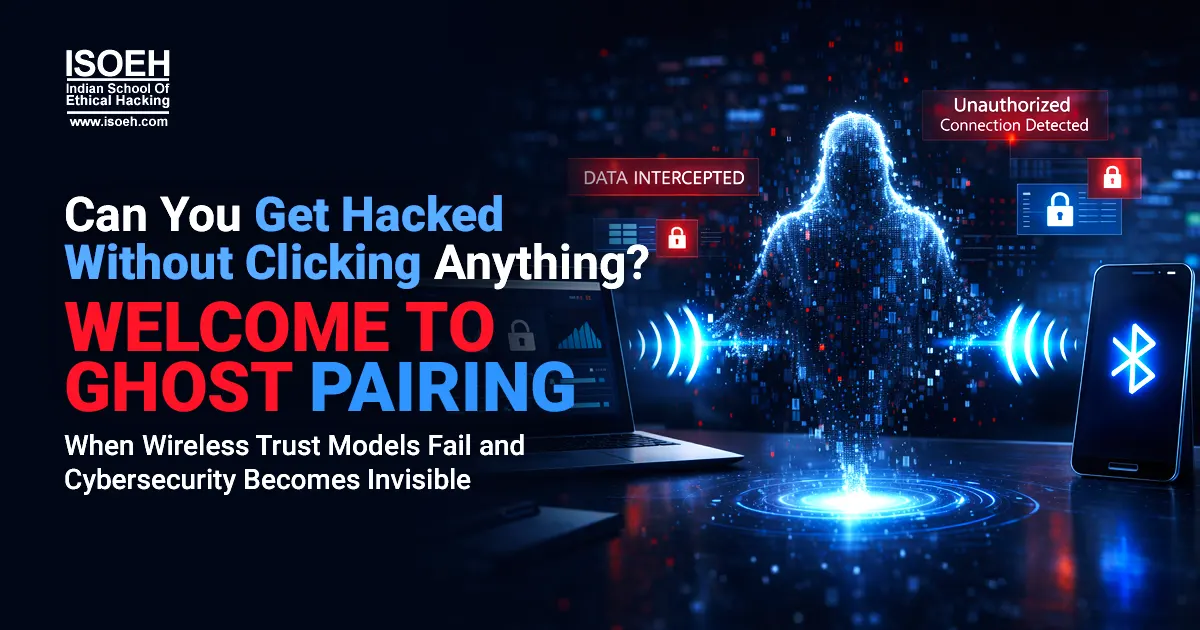
Cybersecurity is often taught as a discipline of user awareness, threat detection, and incident response. Students learn to recognize phishing emails, analyse malware samples, and investigate suspicious network traffic. While these skills remain critical, they represent only one side of modern cybersecurity.
A growing category of attacks operates below the user layer, exploiting protocol behavior, implicit trust, and wireless communication design flaws. One such attack is the Ghost Pairing Attack—a silent yet powerful threat that challenges traditional cybersecurity assumptions and exposes weaknesses in Bluetooth security architecture.
Ghost Pairing Attacks: A Cybersecurity Definition
A Ghost Pairing Attack is a wireless cybersecurity attack in which an attacker establishes or maintains an unauthorized trusted Bluetooth connection with a victim device by exploiting pairing logic flaws, weak authentication mechanisms, or legacy Bluetooth implementations.
From a cybersecurity standpoint, this attack:
- Breaks authentication guarantees
- Exploits long-term trust relationships
- Bypasses explicit user consent
- Operates at the protocol and firmware level
The result is a trusted connection without trustworthiness—a core failure in security design.
Why This Attack Is Dangerous in Modern Cybersecurity
Most defensive cybersecurity strategies rely on visibility:
- Alerts
- Logs
- User prompts
- Security warnings
Ghost Pairing removes these entirely.
- No phishing email
- No malicious attachment
- No suspicious URL
- No security pop-up
This makes Ghost Pairing particularly dangerous for:
- SOC teams
- Digital forensic analysts
- Incident responders
- Enterprise security architects
The attack reinforces a critical cybersecurity principle: If protocol-level trust is compromised, application-level security becomes ineffective.
The Cybersecurity Mechanics Behind Ghost Pairing
To fully understand Ghost Pairing, cybersecurity students must examine Bluetooth security workflows:
1. Wireless Discovery and Trust Establishment
Bluetooth devices frequently broadcast availability and automatically attempt reconnection to previously trusted devices.
2. Exploitation of Weak Pairing Methods
Attackers take advantage of:
- Legacy pairing mechanisms
- "Just Works" authentication
- Reused encryption keys
- Inadequate device identity verification
3. Silent Persistence
Once paired, the attacker gains persistent access to:
- Data exchange channels
- Device control interfaces
- Input and output functions
This is not brute-force hacking—it is trust exploitation through protocol logic.
Expanding Attack Surface: Devices at Risk
Ghost Pairing attacks highlight the rapidly growing wireless attack surface:
- Smartphones and tablets
- Smartwatches and fitness trackers
- Wireless earbuds and peripherals
- IoT and smart home devices
- Automotive infotainment systems
- Medical and industrial Bluetooth devices
For cybersecurity students, this emphasizes a key lesson: Every connected device is part of the security perimeter.
Why Cybersecurity Students Must Study Ghost Pairing
Ghost Pairing attacks provide an excellent learning model for advanced cybersecurity concepts:
- Protocol analysis and packet inspection
- Wireless threat modelling
- Trust and authentication evaluation
- Secure system architecture design
- Offensive and defensive Bluetooth security
Studying such attacks shifts student thinking from tool-based hacking to architecture-based cybersecurity analysis, which is essential for real-world security roles.
Ghost Pairing vs Traditional Cyber Attacks
| Feature | Traditional Cyber Attacks | Ghost Pairing Attacks |
|---|---|---|
| User interaction | Required | Not required |
| Visibility | High | Extremely low |
| Attack layer | Application / Network | Protocol / Firmware |
| Detection | Signature-based | Behavior-based |
| Defense | Reactive | Preventive |
This comparison explains why Ghost Pairing is increasingly discussed in wireless security research and advanced cybersecurity training.
Cybersecurity Defenses Against Ghost Pairing
Mitigating Ghost Pairing attacks requires security-by-design, not just awareness:
- Disable Bluetooth when not required
- Avoid legacy or insecure pairing modes
- Regularly audit paired and trusted devices
- Apply firmware and OS security updates
- Enforce Zero Trust device connectivity
- Monitor abnormal wireless behavior
For cybersecurity professionals, this means defending protocols and trust models, not just endpoints.
The Broader Cybersecurity Lesson
Ghost Pairing attacks expose a fundamental weakness in modern digital systems:
convenience-driven design often sacrifices security.
As wireless technologies continue to expand, attackers increasingly target implicit trust mechanisms rather than exploiting users directly. For cybersecurity students and enthusiasts, understanding these attacks is not optional—it is essential preparation for defending future systems.
Because in modern cybersecurity, the most dangerous compromise is the one that happens silently.
Learn, Defend, and Lead with ISOEH
At ISOEH – Indian School of Ethical Hacking, we believe cybersecurity education must go beyond theory. Understanding attacks like Ghost Pairing prepares students to defend against real-world wireless threats, analyze protocol-level vulnerabilities, and design secure systems in an increasingly connected world.
Our training focuses on:
- Practical ethical hacking and cybersecurity skills
- Real-world attack and defense scenarios
- Deep understanding of network, wireless, and IoT security
- Building industry-ready cybersecurity professionals
In a landscape where attacks can happen without a single click, knowledge becomes your strongest defense.
Learn cybersecurity the ethical way.
Build skills that matter.
Shape the future of digital defense with ISOEH.

Read Other Articles
Read All Articles »
Quick look at the 10 facts you need to know about the latest Facebook hack
Read Details »
Top certifications in cyber security industry
Read Details »
Building a career in IoT: A thorough guide
Read Details »
The mystery of UIDAI : Who & Why!! Is it a threat? A detailed discussion
Read Details »
Top 5 cyber security jobs in the age of Cyber Disruption
Read Details »
Top Cyber Security trends of 2018
Read Details »
A severe vulnerability in Signal desktop app allowing hackers to steal chats in plaintext without any user interaction
Read Details »
Cambridge Analytica and Facebook Controversy: What happened so far?
Read Details »
Equifax identifies an additional 2.4 million U.S. consumers affected by the massive data breach of 2017
Read Details »
Severe flaw in µTorrent can let hackers to control your PC remotely
Read Details »
Cyber Criminals are turning into Cryptominers, Dominating Cyber Threat Landscape
Read Details »
Android Banking Trojan targets over 232 banking apps, including Indian banks
Read Details »
Private end-to-end encrypted Whatsapp group chats are not secured anymore!
Read Details »
Top Cyber Attacks In 2017
Read Details »Hacking Tools
Explore All Hacking Tools »
UFTP is an encrypted multicast file transfer program for secure, reliable & efficient transfer of files. It also helps in data distribution over a satellite link.
Read DetailsBreaking News
Breaking News Of Each Month »
The recent pandemic was unexpected and unknown to most part of the world. It has changed our life and we are slowly adapting to our new lifestyle. The risks associated with the new lifestyle, both personal & corporate, are unknown to most of us.
Read Details